



NVIDIA has updated its open-source RTX Path Tracing (RTXPT) project to version 1.9.0, introducing rendering optimizations that deliver approximately 20% better performance compared with version 1.8.1. According to NVIDIA’s official GitHub documentation, the improvements maintain comparable or better image quality while introducing more efficient path tracing, expanded lighting capabilities, and Windows on ARM64 support.
RTXPT is a developer-focused reference implementation designed to demonstrate modern real-time path tracing techniques. Rather than functioning as a graphics driver update or a feature that automatically improves existing games, it provides developers with code and examples for integrating advanced ray-traced rendering into their own projects.
The performance improvements come from several changes to how RTXPT distributes rendering workloads. One of the most significant additions is optional sub-sampled path tracing, which allows the renderer to trace fewer pixels per frame instead of calculating a full path-tracing sample for every pixel.
Depending on the selected configuration, RTXPT can trace 75%, 50%, or 25% of the pixels in a frame. Faster performance presets also use reduced ray bounce limits, lowering the amount of rendering work required. These adjustments help explain how NVIDIA achieves its reported performance improvement without relying on a single hardware-level optimization.
NVIDIA has also introduced asynchronous compute improvements for DirectX 12. RTXPT can now overlap DLSS Ray Reconstruction and post-processing operations from the previous frame with path tracing calculations for the next frame. This allows different rendering workloads to execute concurrently, improving GPU utilization rather than processing every stage sequentially.
Another optimization moves top-level acceleration structure (TLAS) instance generation onto the GPU, reducing CPU-side processing overhead. Combined with other CPU optimizations, the change helps streamline how complex ray-traced scenes are prepared for rendering.
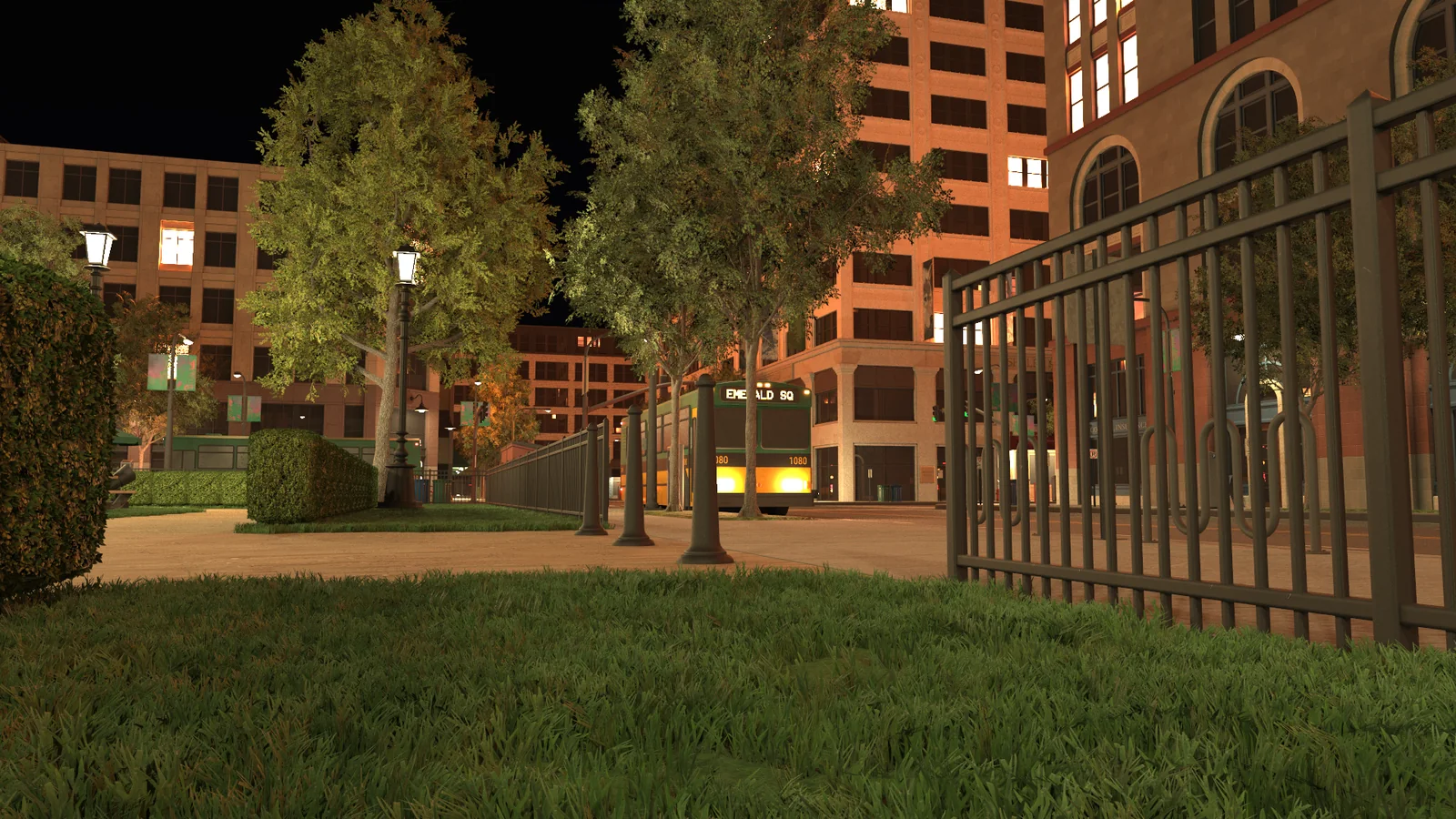
Lighting receives substantial improvements in version 1.9.0. NVIDIA’s Next Event Estimation Adaptive Tree (NEE-AT) system now supports up to two million lights, compared with approximately 512,000 in the previous implementation. The system can also group emissive triangles into different levels of detail, helping manage scenes containing large amounts of light-emitting geometry.
The expanded lighting capacity is particularly relevant to detailed environments containing numerous artificial lights, illuminated surfaces, and complex lighting arrangements. It gives developers a reference for handling substantially larger lighting workloads without treating every light source identically.
NVIDIA has additionally enabled its Spatially Hashed Radiance Cache (SHaRC) by default in RTXPT’s real-time rendering mode. The cache helps reuse indirect lighting information, allowing more lighting data to reach DLSS Ray Reconstruction at approximately the same computational cost.
These techniques are relevant to the broader development of fully path-traced game graphics. Projects such as the AuraV path-tracing mod for GTA V Enhanced demonstrate how advanced lighting techniques can change the appearance of existing games, while Left 4 Dead RTX's ray tracing and DLSS integration illustrates another approach to updating older game visuals.
Beyond rendering performance, RTXPT 1.9.0 introduces compatibility with Windows on ARM64. Developers can now build the project for ARM64 systems using Microsoft’s Visual Studio development tools, with support for cross-compiling from x64 machines.
The addition expands the platforms on which NVIDIA’s reference path tracer can be developed and evaluated. Windows on Arm has also become increasingly relevant to NVIDIA’s hardware ecosystem through RTX Spark laptops featuring Blackwell graphics, although NVIDIA’s RTXPT release notes do not identify a specific hardware product as the reason for adding ARM64 compatibility.
The update also refreshes several integrated development components, including NVIDIA Streamline 2.14.16, RTXDI 3.0, NRD 4.17.3, Opacity Micromap SDK 1.10, and Microsoft’s DirectX Agility SDK 1.619.6. Developers building the latest version now require CMake 4.1 or newer.
RTXPT continues to support DirectX 12 and Vulkan, although some capabilities have different requirements depending on the selected graphics API and hardware. NVIDIA notes that its default DirectX Agility SDK configuration requires DXR 1.2 and Shader Model 6.9, with an alternative build configuration available for GPUs that do not support those features.
The reported 20% improvement specifically compares NVIDIA’s RTXPT 1.9 implementation against version 1.8.1 at comparable or better image quality. It is not a claim that existing RTX games will immediately run 20% faster, nor does it establish identical gains across different GPUs, scenes, or rendering configurations.
For game developers, the release provides updated examples of how sub-sampled rendering, asynchronous workloads, radiance caching, and large-scale lighting systems can work together in a real-time path tracer. Any performance or visual benefits in commercial games would depend on developers adopting and adapting the relevant techniques.
