



MSI has detailed European pricing and configurations for the Prestige N16 Flip AI+, its first laptop built around NVIDIA’s RTX Spark platform. According to pricing published alongside the German launch, the convertible starts at €3,449 for the 32GB configuration, while higher-end versions rise to €4,749 and €7,999. MSI positions the system primarily for local AI, development and creative workloads, but the company also explicitly lists gaming as one of the platform’s intended uses.
All three German configurations use the higher-end NVIDIA RTX Spark N1X implementation with a 20-core Arm CPU and a Blackwell-based GPU containing 6,144 CUDA cores. MSI’s own specification page confirms support for up to 128GB of LPDDR5X unified memory, which is shared across CPU and GPU workloads rather than divided into conventional system RAM and dedicated VRAM. That architecture is aimed heavily at local AI workloads, but it also gives graphics applications and games access to a large common memory pool.
The entry C1XMT-029Y configuration pairs 32GB of unified memory with a 1TB NVMe SSD and a 16-inch 2.8K OLED touchscreen. The 64GB C1XMT-028Y keeps the same 1TB storage and display specification, while increasing the German MSRP to €4,749. At the top of the range, the C1XMT-027Y combines 128GB of unified memory with a 2TB SSD and a higher-resolution 3,840 x 2,400 Tandem OLED panel for €7,999.
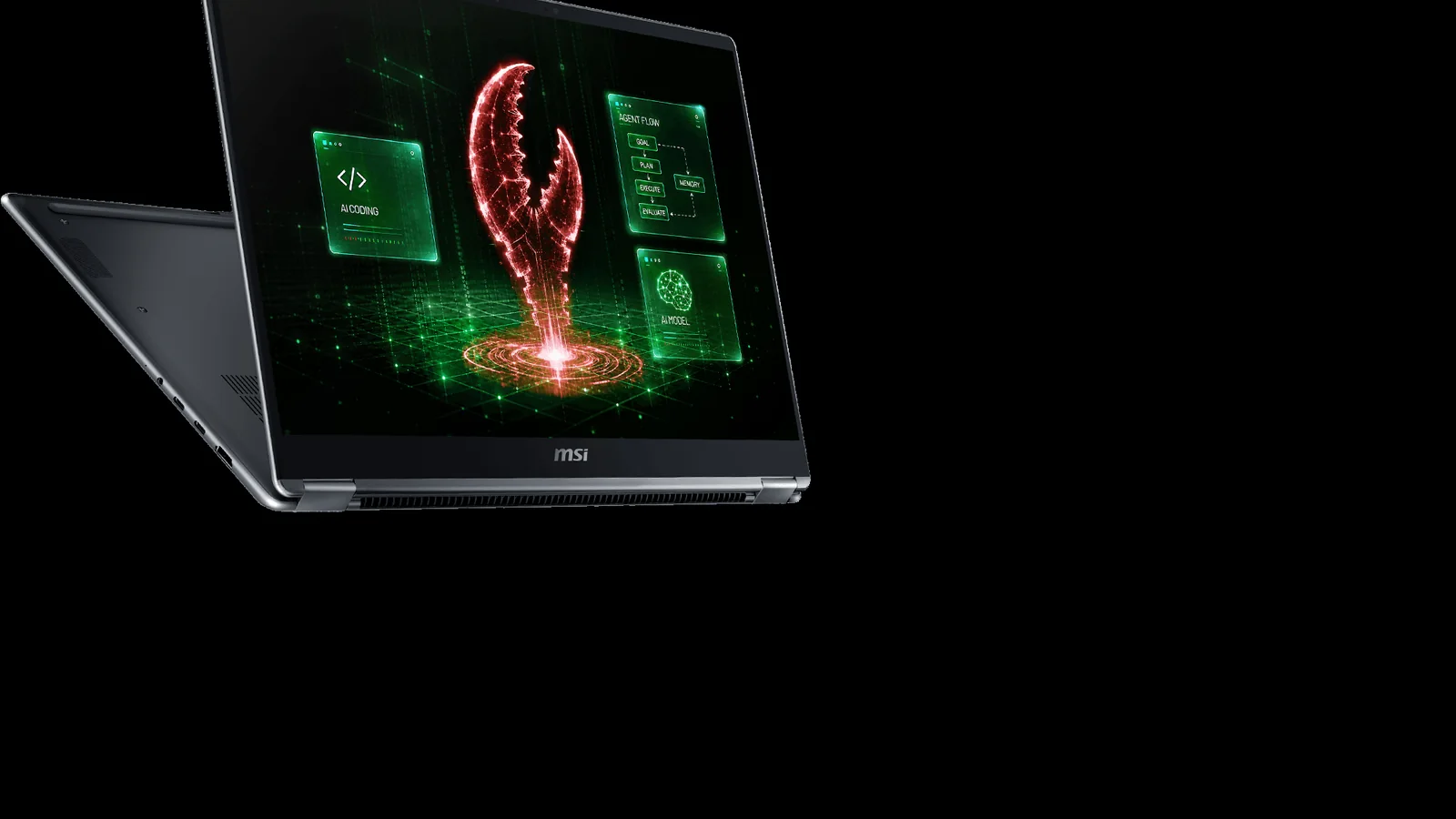
Both available display designs support touch input and a 120Hz refresh rate, while the UHD+ Tandem OLED option is reserved for the flagship model. MSI says that panel can reach up to 1,600 nits of peak brightness, while both display tiers cover roughly 100% of the DCI-P3 color space and support VESA DisplayHDR True Black 1000. The 360-degree hinge allows the machine to function as a conventional notebook, tablet, tent-style device or presentation display, with MSI Nano Pen support included in the overall design.
Despite the Prestige branding and its AI-first positioning, MSI is also marketing the N16 Flip AI+ as a machine capable of gaming with NVIDIA’s wider RTX software stack. The company specifically highlights ray tracing, DLSS and Reflex support, alongside accelerated 3D and content-creation workloads. That puts RTX Spark in an unusual position between traditional GeForce laptops and professional AI systems, rather than making it a direct replacement for a dedicated RTX gaming notebook.
The pricing reinforces that distinction. Even the 32GB model sits well above many conventional gaming laptops, while the €7,999 flagship enters workstation territory. At the same time, increasingly expensive high-end graphics hardware has already pushed some enthusiast products to extreme price levels, with RTX 5090 prices in Germany reaching far beyond normal launch pricing amid limited retail availability.
MSI has equipped the laptop with a 99.9Wh battery and a 140W USB Power Delivery adapter, while cooling is handled by a vapor chamber and the company’s Intra Flow system. Connectivity includes two USB4 Type-C ports, two USB-A 3.2 Gen 2 ports, HDMI 2.1, an SD card reader, Wi-Fi 7 and Bluetooth 5.4. The system measures between 13.9mm and 16.9mm thick and weighs 1.9kg, keeping it relatively slim for hardware with this level of memory and compute capability.
RTX Spark also represents a broader NVIDIA push into Windows PCs built around Arm-based processors and tightly integrated RTX graphics. Microsoft has been expanding Windows gaming infrastructure across different GPU platforms, including its Advanced Shader Delivery support for NVIDIA RTX and Intel Arc hardware, while RTX Spark introduces another hardware target for developers to account for. How well existing games perform on the platform will therefore depend not only on raw GPU capability but also on Windows on Arm compatibility and software optimization.
MSI says the Prestige N16 Flip AI+ is its first RTX Spark laptop and the first announced 2-in-1 convertible in the initial wave of RTX Spark notebooks. German preorders are opening through MSI and retail partners, with market availability expected later in October. The €3,449 starting point makes clear that the first generation is aimed at developers, creators and professional users first, with gaming positioned as an additional capability rather than its primary purpose.
