


A jailbroken PlayStation 4 can now run a 9-billion-parameter AI language model entirely on its own GPU, without requiring a PC, cloud server or internet connection. Developer Leonardo Alegría has released Garlic LLM, an open-source homebrew application that runs Alibaba’s Qwen3.5-9B model on Sony’s 2013-era console hardware. The developer reports text-generation speeds of 31 to 39 tokens per second, reaching up to 43 tokens per second when generating code.
The project includes a downloadable installation package and publicly available source code on GitHub. Unlike conventional AI applications that depend on modern GPU drivers and dedicated machine-learning frameworks, Garlic LLM communicates directly with the PS4’s AMD Graphics Core Next (GCN) architecture through custom compute kernels and manually constructed GPU commands.
According to Alegría’s project documentation, the application was primarily tested on a standard PS4 or PS4 Slim running firmware 11.52 with GoldHEN, a homebrew enabler for exploited consoles. The reported performance figures come from the developer’s measurements and have not been independently verified through standardized benchmarking.
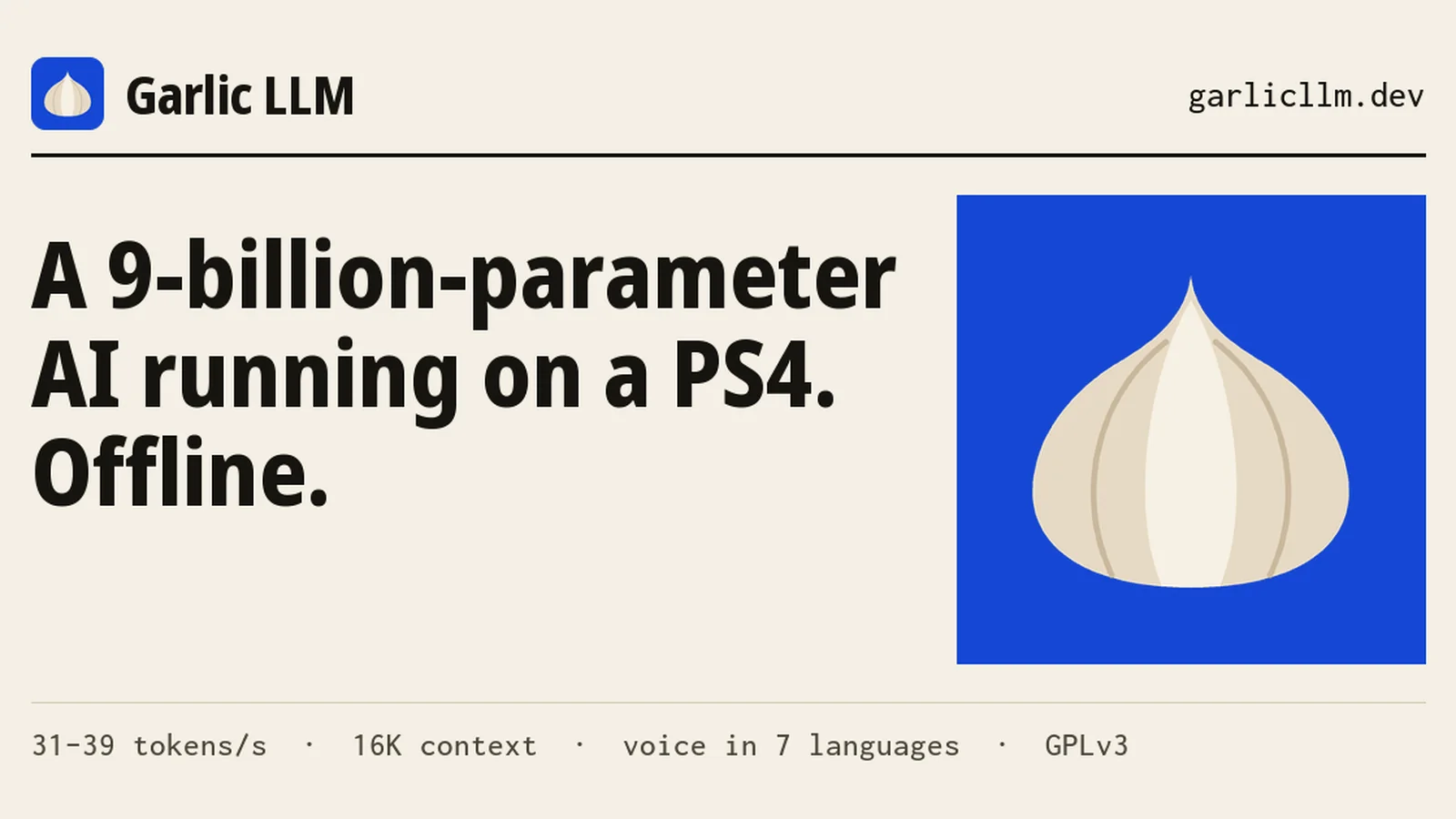
Running a model containing approximately nine billion parameters presents a considerable memory challenge for the PS4, which has 8GB of unified GDDR5 memory shared between its CPU and GPU.
Garlic LLM addresses this limitation through a combination of 4-bit and 3-bit weight quantization. Most model matrices use custom 4-bit weights, while two particularly large matrices in each transformer layer use a more compact format averaging approximately 3.5 bits per weight, including scaling information.
These optimizations reduce the model’s primary weights to approximately 4.5GiB. The application also uses a 4-bit attention cache, allowing it to maintain a 16,000-token context window within the console’s memory limitations.
The developer implemented the model’s mathematical operations using OpenCL C kernels compiled through LLVM for AMD’s GCN architecture. Instead of relying on a conventional graphics or compute driver, Garlic LLM dispatches these operations by constructing low-level PM4 command packets directly.
Model weights reside in a GPU-accessible memory region known as Garlic, which gives the project its name. CPU-side code handles tasks including tokenization, text rendering, the user interface and audio processing.
Another performance optimization involves speculative decoding using Qwen3.5’s multi-token prediction capabilities. The application can predict up to two additional tokens before having the main model verify them, reducing the computational overhead associated with generating responses.
These techniques enable the developer-reported 31–39 tokens-per-second chat performance and peak 43-token-per-second code generation. However, the project’s published results do not provide a complete standardized benchmark methodology, meaning performance should not be interpreted as a guaranteed speed across all prompts and workloads.
Beyond text conversations, Garlic LLM supports spoken interactions using the Chatterbox text-to-speech system. Voice responses are available in seven languages, including English, Spanish, Portuguese, Russian, Italian, French and German.
The application also incorporates NVIDIA’s Parakeet TDT 0.6B v3 speech-recognition model, supporting dictation in 25 European languages. Users can hold a controller button to speak their prompts rather than entering them with the on-screen keyboard.
Voice conversations run at approximately 22 tokens per second, according to the developer, because the additional speech models occupy memory otherwise available for speculative decoding.
A separate Python mode allows users to request programs that the language model writes in MicroPython and executes directly on the console. Garlic LLM also includes an optional reasoning mode, although the developer notes that generating a reasoning response can take approximately half a minute.
The entire application operates locally, with language generation, speech recognition and voice synthesis running on the PS4 itself. The downloadable package includes the necessary models, allowing users to operate it without an active internet connection after installation.
Garlic LLM is distributed as an approximately 5.7GB package through Hugging Face. Installation requires a PS4 running GoldHEN and approximately 6GB of available storage, or 12GB when copying the installation package to the console’s internal drive before installation.
Users can install the package through the PS4’s homebrew Package Installer. The application appears on the console’s home screen and loads its language model when launched.
Although the developer’s principal performance measurements were collected on standard PS4 hardware, community testing has expanded to other configurations. Alegría’s documentation includes a user report of Garlic LLM running on a PS4 Pro with firmware 12.02, producing approximately 25 to 45 tokens per second.
Additional PS4 Pro testing has reportedly reached higher speeds using an experimental native Pro mode, although that configuration is not yet included in the publicly distributed package.
The application does not support PlayStation 5 because its GPU execution code and system integration were developed specifically for the PS4. Garlic LLM itself contains no jailbreak exploit, and users must already have a compatible GoldHEN environment.
The project joins other experimental efforts to repurpose console hardware beyond conventional gaming. Recent developments have included experimental PS5 game emulation on jailbroken PS4 consoles, demonstrating how homebrew developers continue exploring the capabilities of older PlayStation systems.
Similar hardware experimentation has also extended to unconventional computing devices, including an experimental driver that renders the Windows 11 desktop using an Intel NPU.
Garlic LLM’s source code is available under the GPLv3 license, while its bundled AI models retain their respective licenses. The application was developed using the open-source OpenOrbis PS4 toolchain, with installation instructions, technical documentation and model-conversion utilities included in the public repository.
The project demonstrates that the PS4’s aging AMD GPU can perform local language-model inference when paired with specialized quantization and low-level software optimizations, although its performance claims remain developer-reported rather than independently benchmarked.
