


Maxsun has revealed updated specifications for two upcoming NAS-focused motherboards powered by Intel’s Panther Lake and Wildcat Lake mobile processors. The SK-PTLNAS and SK-WCLAIO use Mobile on Desktop (MoDT) designs, combining soldered laptop processors with desktop-oriented storage, memory and networking connections. Both boards were originally showcased at Computex 2026 and are reportedly scheduled for release in November, although pricing and regional availability remain unconfirmed.
The new specifications reveal substantial differences between the two models. The larger Panther Lake board supports up to 128GB of DDR5-7200 memory, five M.2 storage slots and PCIe 5.0 expansion, while the smaller Wildcat Lake design offers four M.2 slots, integrated UFS storage and a compact 90 × 165mm footprint. Both provide 10Gb Ethernet connectivity, targeting home servers, network-attached storage systems and specialized compact PC builds.
Maxsun’s SK-PTLNAS uses Intel Core Ultra Series 3 processors, with configurations now listed up to the Core Ultra 9 386H. The Panther Lake chip features 16 CPU cores and four Xe3 integrated graphics cores, with a 25W base power rating and a maximum turbo power rating of 80W. Earlier specifications displayed at Computex mentioned the more powerful Core Ultra X9 388H, but that processor is absent from the latest configuration details.
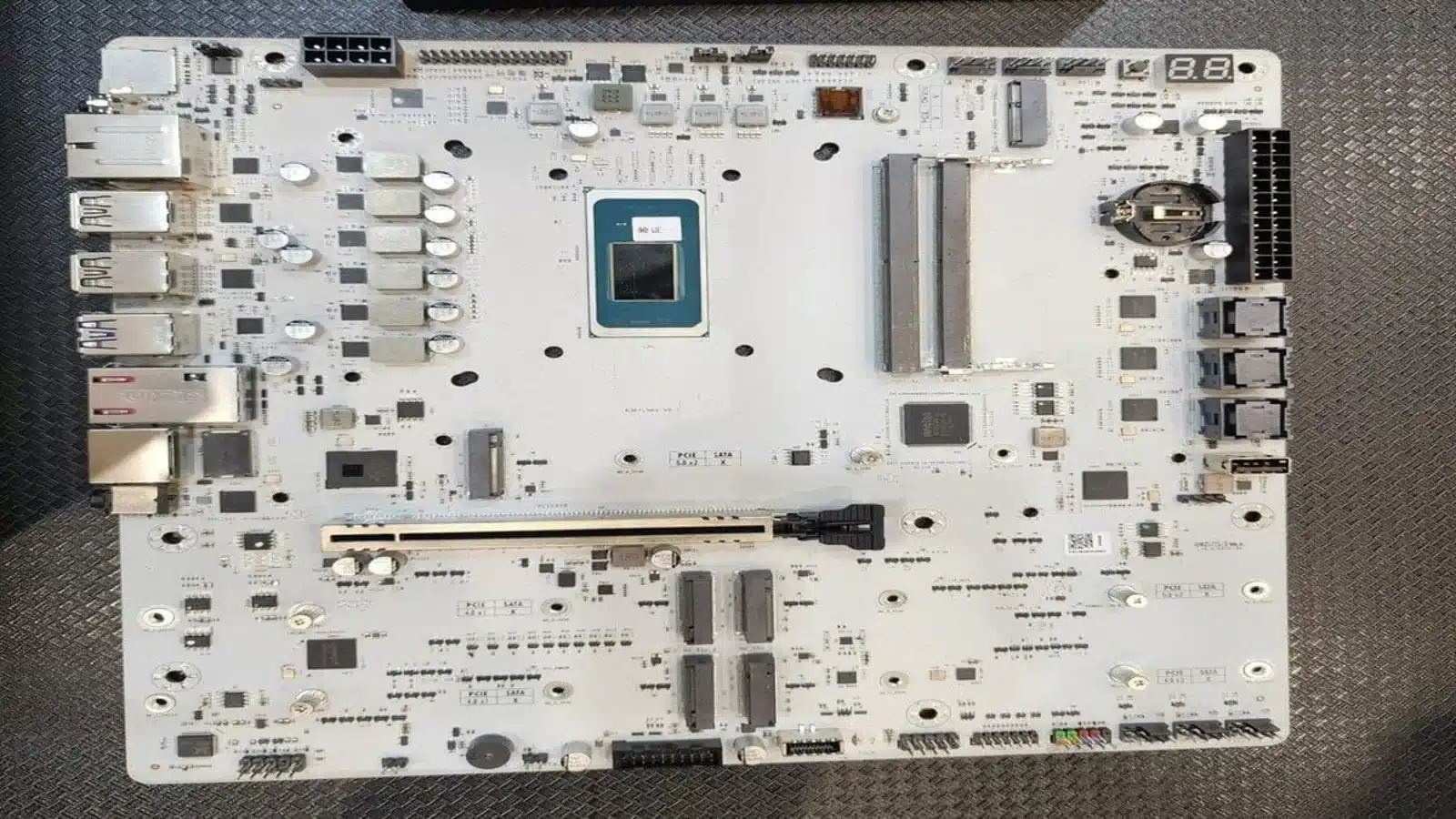
Measuring 244 × 244mm, the SK-PTLNAS features a 6+4-phase power delivery system and two SO-DIMM slots supporting up to 128GB of DDR5-7200 memory. Its five M.2 storage connections consist of two PCIe 5.0 x2 slots, one PCIe 4.0 x2 slot and two PCIe 4.0 x1 slots. Three additional SFF-8643 Mini SAS connectors provide options for connecting multiple storage drives.
The motherboard also includes a full-length PCIe 5.0 expansion slot operating at x8 bandwidth. Networking consists of one 10GbE port, one 2.5GbE port and two 1GbE ports, alongside two Thunderbolt 4 connections and additional USB interfaces. Maxsun lists compatibility with Windows 11 and Ubuntu, making the board suitable for several types of storage and desktop configurations.
The combination of multiple storage interfaces, substantial memory capacity and high-speed networking makes the SK-PTLNAS particularly relevant to enthusiasts assembling home servers or centralized storage systems for large game libraries and media files. Its PCIe expansion slot also provides flexibility for additional hardware, although the integrated Xe3 graphics have not been independently benchmarked in this motherboard configuration.
The smaller SK-WCLAIO takes a different approach. Powered by Intel’s Wildcat Lake Core 7 350, it features six CPU cores arranged as two performance cores and four low-power efficiency cores, alongside two Xe3 graphics cores. Intel rates the processor at 15W base power and up to 35W maximum turbo power.
Maxsun has substantially redesigned the Wildcat Lake motherboard since its Computex appearance. Instead of the earlier micro-ATX-style layout, the updated SK-WCLAIO measures just 90 × 165mm. Despite its reduced dimensions, it provides a single DDR5-6400 SO-DIMM slot supporting up to 48GB of memory, four M.2 2280 storage slots and 1TB of integrated UFS 3.1 storage.
Connectivity includes 10Gb Ethernet, two Thunderbolt 4 ports, HDMI 2.0, DisplayPort 1.4 and expansion interfaces for wireless networking and cellular connectivity. The updated specifications also mention USB-C Power Delivery supporting a 100W adapter, although published power-input information is not entirely consistent.
Maxsun lists approximately 45W of active system power consumption and 16W with storage drives in standby for the Wildcat Lake design. Those figures suggest potential suitability for continuously operating NAS installations, but real-world electricity consumption will depend on the final configuration and connected storage devices.
One limitation of the smaller board is its available PCIe bandwidth. Although four M.2 slots are provided, Wildcat Lake’s limited PCIe connectivity means users should not assume that every SSD can operate with a dedicated four-lane connection at maximum speed. Detailed bandwidth allocation and simultaneous-drive performance have not yet been independently established.
Both motherboards demonstrate how Intel’s mobile processors can be adapted for desktop systems requiring compact dimensions and extensive connectivity. Panther Lake is also appearing in conventional compact PCs, including the TUXEDO Nano Pro Gen15 with Intel Arc B390 graphics, although Maxsun’s boards prioritize storage expansion and networking over a complete ready-to-use desktop system.
The updated specifications arrive as Intel’s Panther Lake platform faces broader manufacturing considerations, including reported capacity shifts toward Xeon production. However, there is no confirmed indication that those changes will affect Maxsun’s motherboard availability.
Maxsun has not disclosed retail pricing, international distribution plans or independently verified performance figures for either model. Both boards are expected to arrive during November 2026, with final availability and configuration details still to be confirmed.
