


An unofficial NVIDIA GeForce RTX 2080 Ti modified with 22GB of GDDR6 memory has delivered substantial performance improvements over the original 11GB model in demanding PC games. New benchmarks published by German hardware outlet PC Games Hardware on November 1, 2026, show gains of approximately 74% in Microsoft Flight Simulator 2024 and 62% in Marvel’s Spider-Man 2 under memory-intensive 4K settings.
The results demonstrate how additional video memory can extend the usefulness of NVIDIA’s aging Turing architecture when games exceed the original card’s VRAM capacity. However, the benefits vary considerably between games, and the modification does not increase the GPU’s underlying processing capabilities.
PC Games Hardware conducted the original testing using a modified RTX 2080 Ti supplied by a reader. The publication compared its performance against a standard 11GB configuration while matching operating frequencies and power settings to isolate the effects of additional memory.
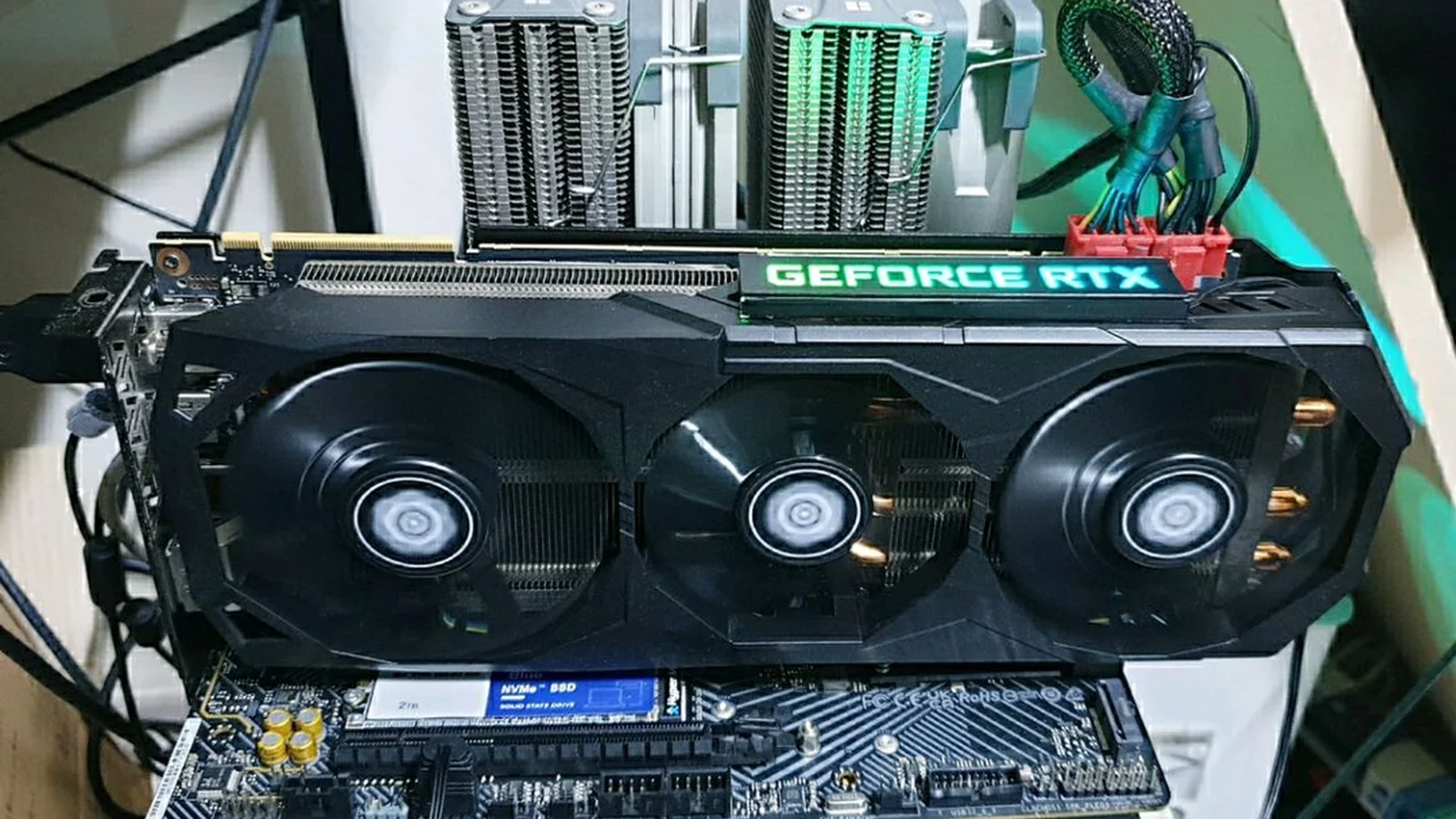
In Microsoft Flight Simulator 2024, the modified card averaged 52.5 FPS at 4K with DLSS Performance and AMD FSR 3.1 Frame Generation, compared with 30.2 FPS on the 11GB configuration. Marvel’s Spider-Man 2 increased from 39.4 FPS to 64.0 FPS under the same resolution and upscaling conditions.
These represent improvements of approximately 74% and 62%, respectively. The figures include generated frames rather than exclusively native rendering performance, making the results particularly relevant to players using modern upscaling and frame-generation techniques on older hardware.
The difference was less dramatic at 2560×1440 with DLSS Quality. Both Flight Simulator 2024 and Spider-Man 2 still showed meaningful improvements, with the 11GB version delivering approximately 20% lower frame rates in the tested scenarios.
PC Games Hardware deliberately selected nine games known to place unusually high demands on graphics memory. The publication acknowledged that most games in its broader benchmark suite already perform adequately with 11GB of VRAM, so these results should not be interpreted as typical performance gains across all PC games.
The most severe limitation appeared in Indiana Jones and the Great Circle. Under the demanding 4K test configuration, the standard 11GB RTX 2080 Ti repeatedly crashed to the desktop, while the modified 22GB model could complete the test.
Other games, including Cyberpunk 2077 and Dragon Age: The Veilguard, experienced substantial frame-time instability on the original configuration. When the available VRAM became insufficient, the GPU had to move data between graphics memory and system RAM, introducing delays and visible stuttering.
The modified card delivered more consistent frame times in these scenarios, reducing the interruptions associated with memory pressure. This distinction matters because average FPS alone does not fully represent gaming smoothness, particularly in titles that continually stream large environments, textures and other graphical assets.
The testing also revealed how much memory certain modern games can allocate when sufficient capacity is available. At 4K with frame generation, Spider-Man 2 reached approximately 13.9GB of allocated VRAM, while Pragmata reached 13.2GB and Flight Simulator 2024 reached 12.9GB.
These figures represent allocated memory rather than a universal minimum requirement. Games can adjust memory usage based on available capacity, graphics settings and their streaming systems. Nevertheless, the comparison provides direct evidence of performance penalties when the original 11GB configuration becomes constrained.
Additional VRAM also allowed the modified GPU to access certain graphics options unavailable on the standard card. PC Games Hardware identified 12GB memory requirements for the highest-quality settings in 007 First Light and Gears of War: E-Day, including their respective advanced rendering features.
That does not guarantee playable performance. Even with the expanded memory, Gears of War: E-Day managed approximately 17 FPS under the publication’s particularly demanding test configuration. The result illustrates that removing a memory restriction cannot compensate for insufficient rendering power.
The RTX 2080 Ti modification itself involves replacing the original eleven 1GB GDDR6 memory chips with eleven 2GB Samsung chips, doubling the capacity to 22GB. A hardware configuration resistor is also repositioned so the GPU recognizes the larger memory arrangement.
According to PC Games Hardware, the modification requires no custom firmware or BIOS flashing, and the resulting card operates with standard NVIDIA GeForce drivers. It remains an unofficial hardware modification rather than a product manufactured or endorsed by NVIDIA.
The original RTX 2080 Ti retains its 4,352 CUDA cores, 352-bit memory interface and Turing architecture. Doubling VRAM capacity does not double memory bandwidth or increase shader performance, which explains why the benefits are concentrated in situations where memory capacity is the primary limitation.
This distinction also applies to other attempts to extend older NVIDIA hardware capabilities, including experimental RTX 20, 30 and 40 series performance modifications targeting Tensor Core workloads. Such modifications address specific hardware limitations rather than delivering universal improvements.
For its gaming comparison, PC Games Hardware configured both versions to approximately 1.9GHz GPU frequency, 15GT/s memory speed and a 280W board power limit. These settings were necessary partly because the modified card’s blower-style cooling system and original 250W power limit restricted its performance.
Cooling remained a significant drawback. The publication measured the modified card’s blower fan approaching 4,000 RPM under sustained load, with noise reaching 9.8 sone. These characteristics make the hardware less attractive for a conventional gaming desktop, even when its additional memory provides measurable benefits.
Modified RTX 2080 Ti 22GB cards are available through third-party marketplaces for approximately €500, although prices vary by seller. PC Games Hardware highlighted the risks associated with purchasing an eight-year-old GPU that has undergone extensive soldering work, including potential component failures that may appear weeks after purchase.
The publication recommended assessing seller reliability and warranty coverage before considering such hardware. An inexpensive card with unusually high VRAM capacity is not necessarily a better purchase than a newer GPU offering improved performance, efficiency, features and manufacturer support.
The benchmarks ultimately establish a specific advantage for expanded VRAM: when an otherwise capable graphics processor becomes constrained by memory capacity, additional VRAM can improve average frame rates, stabilize frame delivery and prevent certain failures. For games that already fit comfortably within 11GB, however, the modified RTX 2080 Ti offers little performance advantage over the original.
