


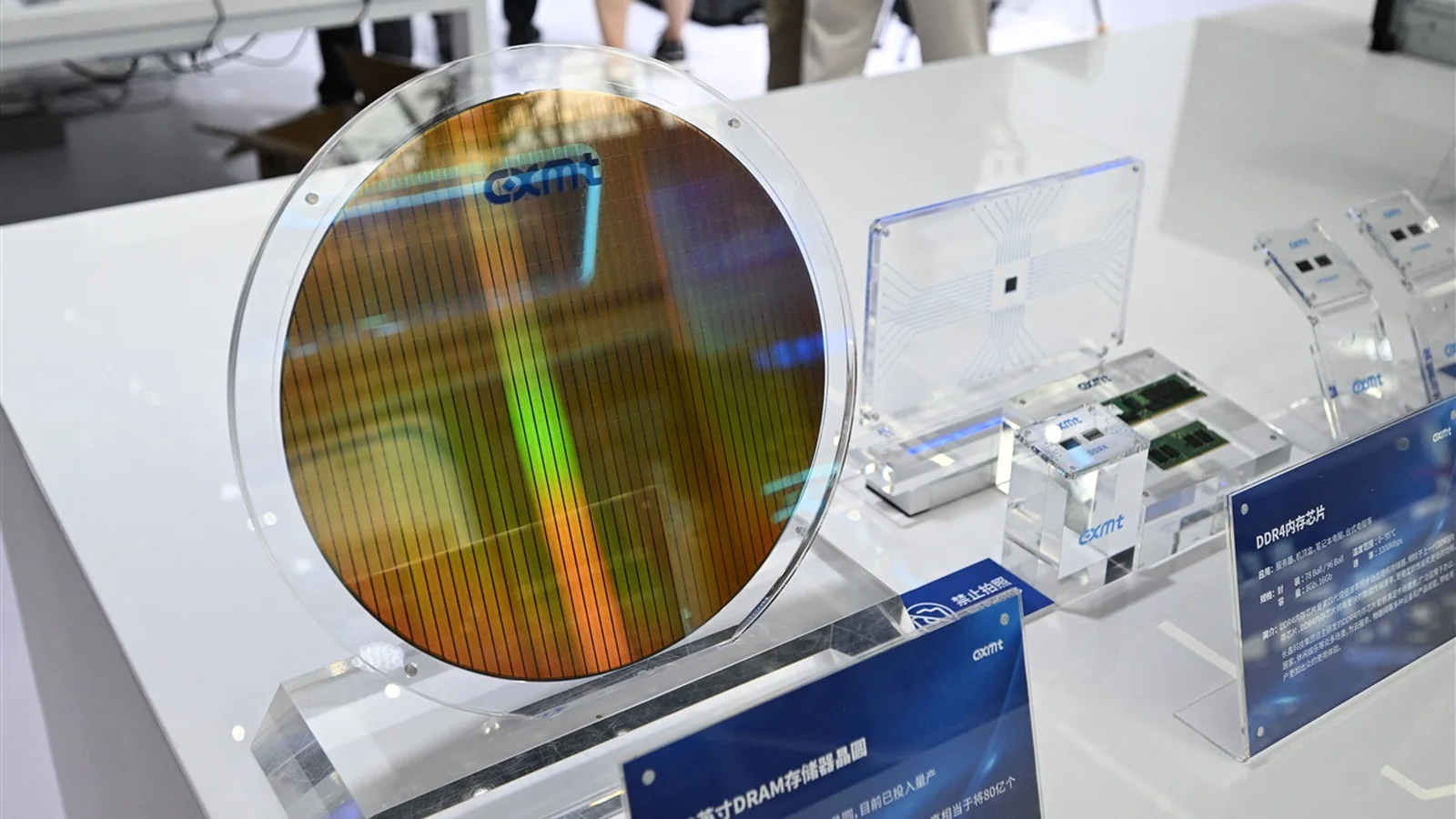
Chinese memory manufacturer ChangXin Memory Technologies (CXMT) has reported an 89.53% gross margin for the third quarter of 2026, surpassing comparable figures reported by major competitors while confirming a significant milestone in its next-generation DRAM manufacturing technology. The company also announced that engineering samples produced using its sixth-generation 4F² architecture have successfully completed validation.
The financial results, disclosed following CXMT’s October 30 earnings presentation, highlight how strongly the manufacturer is benefiting from the global memory shortage. They also challenge expectations that expanding Chinese DRAM production will necessarily bring cheaper DDR5 memory to PC builders.
CXMT’s third-quarter gross margin increased by 1.94 percentage points compared with the previous quarter, reaching 89.53%. For comparison, Micron reported a gross margin of approximately 87% for its quarter ending September 3, while Samsung’s consolidated gross margin reached 69.3% during the third quarter of 2026. These figures reflect different reporting periods and business mixes, particularly in Samsung’s case, but illustrate the exceptional profitability CXMT is currently achieving.
The company’s third-quarter revenue reached approximately 118.71 billion yuan, representing an increase of 613.18% year over year and 19.30% quarter over quarter. Revenue for the first nine months of 2026 climbed to approximately 269.02 billion yuan, up 738.51% compared with the same period last year.
Net profit attributable to shareholders reached approximately 132.04 billion yuan over those nine months, reversing a loss recorded during the corresponding period in 2025.
CXMT attributed its improving gross margin primarily to higher product selling prices and a shift toward more profitable memory products. The company expects margins to remain stable during the fourth quarter, supported by continued demand and manufacturing efficiencies.
That pricing strategy has important implications for consumer memory buyers. During its earnings discussions, CXMT indicated that its products are generally priced in line with competing overseas manufacturers rather than being systematically offered at substantial discounts.
Although additional production capacity could eventually improve global DRAM availability, CXMT’s current profitability and pricing approach provide little evidence of an imminent reduction in consumer RAM prices.
The situation reflects broader pressure across the memory industry. SK hynix expects memory supply constraints to persist through 2030 as AI infrastructure investments increase demand for manufacturing capacity and high-performance memory.
Major technology companies are also attempting to secure future supplies. Alibaba, Tencent and ByteDance have reportedly pursued long-term DRAM supply agreements amid concerns about availability and pricing.
CXMT is pursuing similar arrangements with several major customers, seeking more predictable demand and longer-term sales commitments.
Beyond its financial results, CXMT confirmed that its sixth-generation DRAM technology platform, based on a 4F² vertical-channel architecture, has completed engineering-sample validation.
The development represents progress toward increasing DRAM density without relying exclusively on conventional transistor scaling.
Current mainstream DRAM designs commonly use a 6F² cell layout, where F represents a fundamental lithographic feature dimension. A 4F² layout reduces the nominal memory-cell footprint to approximately two-thirds of the area required by a comparable 6F² design.
In principle, smaller memory cells allow manufacturers to place more storage capacity on a silicon wafer, potentially improving manufacturing efficiency and reducing cost per bit. Actual benefits depend on manufacturing yields, process complexity and successful commercialization.
CXMT’s approach uses vertically arranged transistors rather than relying entirely on conventional planar cell structures. The company has also developed hybrid-bonding techniques intended to support its advanced memory architecture.
According to disclosures from its October 30 presentation, engineering samples have met the platform’s targeted performance requirements on actual wafers. However, successful engineering validation does not establish that the process is ready for commercial mass production.
CXMT expects to provide initial samples of DDR5 registered DIMMs based on the 4F² architecture by the end of 2026. These first-generation products are intended primarily for server applications, where higher memory density is particularly valuable.
Mass production will depend on subsequent customer validation and market demand. The company has not announced a confirmed commercial production date or consumer DDR5 product launch using the new architecture.
Other memory manufacturers are investigating different approaches to future DRAM scaling. Samsung and SK hynix continue developing 4F² technologies, while SK hynix is also pursuing three-dimensional DRAM. Micron has indicated that it does not currently consider 4F² the preferred route for its own manufacturing roadmap, citing cost and yield considerations.
CXMT’s validated prototypes therefore represent a meaningful technical milestone, but not proof that its manufacturing technology has surpassed competing commercial processes.
For PC enthusiasts, the immediate development is financial rather than a new consumer memory product. CXMT is selling DRAM into a market characterized by tight supply and strong pricing, while its advanced manufacturing research is initially focused on server memory.
The company’s latest results reinforce concerns about long-term DRAM supply commitments limiting the amount of memory available to other buyers.
Whether CXMT’s future manufacturing expansion eventually improves the affordability of DDR5 kits for gaming PCs remains uncertain. Its 4F² validation advances the company’s production roadmap, but neither the new architecture nor its current earnings establish when consumer memory prices might decline.
